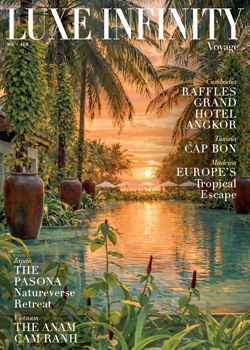
By Ema Lynnx
Au Cambodia, a few minutes from the temples of Angkor, the Raffles Grand Hotel d'Angkor has been part of the landscape for almost a century. Inaugurated in 1932, it witnessed the passage of the first travelers fascinated by the vestiges of the Khmer Empire, at a time when Siem Reap it was still just a small, peaceful town.
Over the decades, the five-star hotel has become a true institution. More than just a place to stay, it tells a part of the story of Angkor and Cambodia, while retaining the charm of the great Asian hotels that have stood the test of time.
Upon arrival, the pace changes. Behind the majestic, centuries-old trees lining Avenue Charles de Gaulle, the hustle and bustle of Siem Reap gradually fades away. Your gaze is immediately drawn to the imposing white Art Deco façade, perfectly integrated into a vast tropical garden. The atmosphere evokes the great expeditions of the 1930s, when explorers, archaeologists, and writers would stop here before setting off to discover the lost city of the Khmer kings.

Opened in 1932, the Grand Hotel d'Angkor It was the first true luxury hotel built in Siem Reap. At that time, the Angkor site was gradually regaining its place among the world's greatest archaeological discoveries, and the first wealthy travelers were flocking to admire the temples recently restored by the École française d'Extrême-Orient (French School of Asian Studies). The hotel was designed to cater to this new international clientele, offering an unprecedented level of comfort in this still relatively undiscovered region.
Like its sister hotel in Phnom Penh, the Raffles Grand Hotel Angkor has witnessed the most significant moments in Cambodian history. After decades marked by conflict, it was reborn in 1997 under the Raffles brand, following an exemplary restoration that preserved its original architecture while providing the comfort of a contemporary five-star hotel. Even today, it is often called "the Grand Dame of Angkor," a distinction that perfectly encapsulates its status.


The architecture retains all the charm of the grand hotels Asian colonials. The high ceilings, the black and ivory checkered floors, the elegant Art Deco ironwork, the wide, light-filled corridors and the precious wood furniture create an atmosphere where every detail seems to tell of an era when travel was above all an adventure.
The rooms and suites extend this understated elegance. Cambodian silk fabrics, fine wood floors, ceiling fans, and bespoke furniture evoke the refinement of the 1930s, while the amenities naturally meet the expectations of today's travelers. All benefit from the renowned Raffles butler service, a true hallmark of the brand for over a century.
Some suites pay homage to the great explorers who helped bring Angkor to the world's attention. The Henri Mouhot, Louis Delaporte, Henri Marchal, and John Thomson suites evoke these pioneers who, each in their own way, contributed to revealing Khmer heritage to the West. It's an elegant way to extend the ongoing dialogue between history and travel that permeates the entire hotel.


The heart of the hotel beats around its immense 35-meter swimming pool, one of the most iconic in Cambodia. Surrounded by frangipani trees and tropical gardens, it invites you to slow down after a day spent under the Angkor sun. Just a few steps away, the Raffles Spa extends this tranquil escape with treatments inspired by Cambodian traditions, while the tennis courts, relaxation areas, and shaded terraces contribute to this feeling of an oasis in the heart of Siem Reap.
Gastronomy also plays a vital role. The 1932 restaurant, named in homage to the year the hotel opened, reinterprets Cambodian culinary heritage with a contemporary approach, while the Café d'Angkor offers international cuisine in a more relaxed atmosphere. The iconic Elephant Bar, a true local institution, perpetuates the art of the cocktail according to Raffles tradition, in a setting that seems frozen in time.
But the true wealth of the Raffles Grand Hotel Angkor undoubtedly lies in its proximity to the UNESCO World Heritage temples. In just ten minutes, the first stones of Angkor come into view. The hotel staff organizes tailor-made experiences, from private sunrise tours to guided discoveries led by specialists in Khmer history.


The temples of Angkor are distinguished by their monumental architecture, deeply linked to Hindu and later Buddhist beliefs. Many are designed as symbolic representations of Mount Meru, the center of the universe in Hindu cosmology, with sanctuary towers, concentric enclosures, moats, and long sculpted galleries. Each structure, however, possesses its own unique identity: Angkor Wat impresses with its symmetry and exceptionally fine bas-reliefs; the Bayon with its famous towers adorned with monumental faces; Ta Prohm with its ruins entwined in the roots of kapok and fig trees; while Banteay Srei It is distinguished by the delicacy of its sculptures made in pink sandstone. Beyond their religious function, these temples testify to the power of the Khmer sovereigns, their mastery of architecture and hydraulics, but also to the spiritual evolution of the Empire, from Hinduism to different forms of Buddhism.
It's difficult to remain unmoved while exploring the Angkor site. From the very first steps, a profound sense of calm takes hold, almost surreal. The stones bear the marks of centuries of history, while the trees seem to embrace the temples like a protective embrace, a symbiotic union. The silence is broken only by birdsong or the rustling of leaves, and one experiences a mixture of fascination, humility, and wonder. More than just a visit, Angkor invites you to slow down, observe, and appreciate the genius of the Khmer civilization. It's a place that leaves a lasting impression, as much through its beauty as through the unique atmosphere it exudes.


Back at the hotel, one understands why so many famous figures have chosen to stay here. Charlie Chaplin, Jacqueline Kennedy, Charles de Gaulle, President Barack Obama, Roger Moore, and José Carreras are among the guests who have contributed to the hotel's legendary status. Yet, despite this prestigious history, the atmosphere remains surprisingly serene. Nothing seems ostentatious. Everything appears designed to let Cambodia itself take center stage.
Staying at the Raffles Grand Hotel Angkor is, ultimately, about rediscovering the spirit of travel as it once existed. A time when one took the time to observe, understand, and immerse oneself in a place. More than just an address, this hotel remains the natural companion for exploring Angkor, offering a rare balance between heritage, hospitality, and timeless elegance. For many, it is not simply the finest address in Siem Reap; it is an integral part of the journey itself.
Photos: Patrick Koune